



Louis Vuitton: History of the House, Appraisals, and Auctions

Key takeaways
- Founded in 1854 in Paris by Louis Vuitton, the company became the world’s leading luxury brand after joining LVMH in 1987.
- The Monogram canvas, created in 1896, and the Damier canvas, from 1888, are the brand’s iconic signatures, although their global recognition makes them vulnerable to widespread counterfeiting.
- Antique trunks and vintage bags such as the Speedy (1930), Keepall, and historic cabin trunks fetch the highest prices at specialized auctions, depending on their condition and documented provenance.
Monogram canvas, travel trunks, and a luxury empire founded in 1854: the value of Louis Vuitton items varies greatly depending on the model, series, and condition.
Below, you’ll find all our valuation guides dedicated to Louis Vuitton—including Louis Vuitton bags, trunks, and leather goods. Each guide details the price ranges observed at auction and the factors that determine an item’s value before it is entrusted to our state-certified auctioneers.
Guides on this brand
See all guides >
Marseille Auctioneer: Art Valuation – Aucties
Have your artwork, jewelry, and collectibles appraised in Marseille by the experts at Aucties. 100% free online appraisal within 24 hours. ✅
Learn more >

Rating and value of furniture, bindings and drawings by Pier...
Pierre Legrain is a twentieth-century decorator and bookbinder whose works are highly prized at auction.
Learn more >

Estimation and expertise of Louis Vuitton trunks, suitcases...
Louis Vuitton trunks are a staple of the luxury house that appeal to bidders. As their value increases, so does their value.
Learn more >

Estimation and expertise : Sell your Hermès Birkins at aucti...
The Birkin is a timeless Hermès model, with a value that never goes down, and a quotation that never goes up. Discover its value.
Learn more >
Louis Vuitton: From Parisian Luggage Maker to Global Luxury Empire
In 1854, Louis Vuitton opened his workshop on Rue Neuve-des-Capucines
In 1854, Louis Vuitton set up shop on Rue Neuve-des-Capucines in Paris, in one of the busiest neighborhoods of the capital during the Second Empire. This workshop, specializing in the packing and crafting of travel trunks, marked the beginning of an entrepreneurial adventure whose scope would exceed all of its founder’s reasonable expectations.
The Trade of the Luggage Packer Serving the Great Houses
The profession of “layetier-emballeur”—which involved preparing and packing clients’ personal belongings for their travels—was then a prestigious occupation in a bourgeois and aristocratic society devoted to comfort and elegance while traveling. Louis Vuitton excelled in this art, quickly attracting the attention of the capital’s most discerning clients.
A family-owned business that became a luxury giant within LVMH
Remaining a family-owned business for over a century, Louis Vuitton joined Bernard Arnault’s LVMH group in 1987—a structure that allowed it to expand its international network while preserving its creative identity and its position at the pinnacle of the global luxury market.
Date | Key Event |
1821 | Louis Vuitton is born in the Jura region |
1854 | Opening of the workshop on Rue Neuve-des-Capucines |
1858 | Invention of the flat trunk |
1888 | Creation of the Damier canvas by Georges Vuitton |
1896 | Creation of the Monogram canvas |
1987 | Merger with Moët Hennessy; founding of LVMH |
2014 | Inauguration of the Louis Vuitton Foundation by Frank Gehry |
Today | The world’s leading luxury brand |
Estimate in less than 24h
Louis Vuitton, the man who reinvented the art of travel
1821: A Boy from the Jura Sets Out on Foot for Paris
Louis Vuitton was born in 1821 in the small town of Anchay, in the Jura region. At the age of thirteen, he set out on foot for Paris, traveling about four hundred kilometers across France to reach the capital and learn a trade there.
This formative journey, which lasted two years, shaped the character of a man who would devote his entire life to perfecting the art of travel.
Empress Eugénie’s Personal Packer
The quality of Louis Vuitton’s work eventually caught the attention of those closest to the imperial court, and it was ultimately Empress Eugénie, wife of Napoleon III, who chose Louis Vuitton as her official packer.
This appointment served as official recognition of his impeccable craftsmanship and provided an unparalleled showcase for the young company.
The Invention of the Flat Trunk: A Revolution in Travel Luggage
In 1858, Louis Vuitton invented the flat trunk, whose flat lid replaced the traditional domed lid of the trunks of the time. This seemingly minor innovation revolutionized the art of luggage: flat trunks could be stacked effortlessly, greatly optimizing vehicle loading and allowing for the efficient organization of the traveler’s belongings.
Asnières-sur-Seine, the birthplace and historic workshop of the company
1859: The workshops are established along the Seine
Rapid growth in demand prompted Louis Vuitton to move its production workshops to Asnières-sur-Seine in 1859, into a family home that still houses the brand’s most iconic workshops today.
This historic site, which remained in the family until it was integrated into the LVMH Group, stands as a unique landmark in the history of French luxury.
The Family Home Turned Louis Vuitton Museum
The family home in Asnières, where Louis Vuitton himself lived and worked, is now partially open to visitors as a museum chronicling the brand’s history, offering a unique immersion into the original world of the workshop.
Luggage-making expertise passed down for over a century
The art of trunk-making—which involves crafting trunks with perfectly right angles, impeccable hinges, and canvas stretched to perfection—continues to be practiced in Asnières using techniques passed down since the brand’s inception, ensuring that every trunk produced is of exceptional artisanal quality.
Since its inception, production in Asnières has relied on specialized artisans—seamstresses, lining makers, and canvas workers—whose training within the workshops themselves ensures the transmission of professional techniques specific to the house.
Each trunk produced in this workshop today represents the culmination of centuries-old expertise, which directly contributes to the considerable premium in value enjoyed by the oldest pieces on the secondary market.
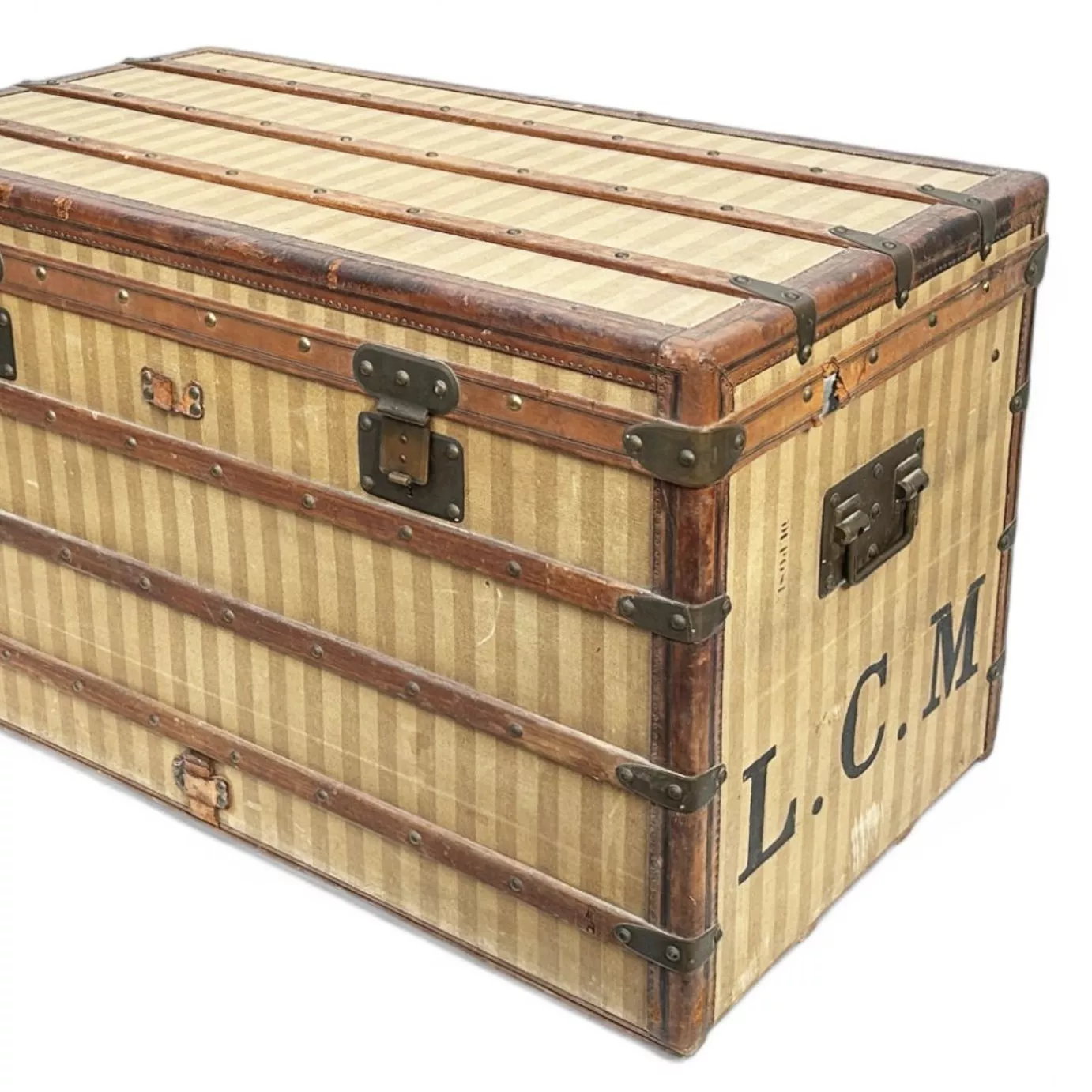
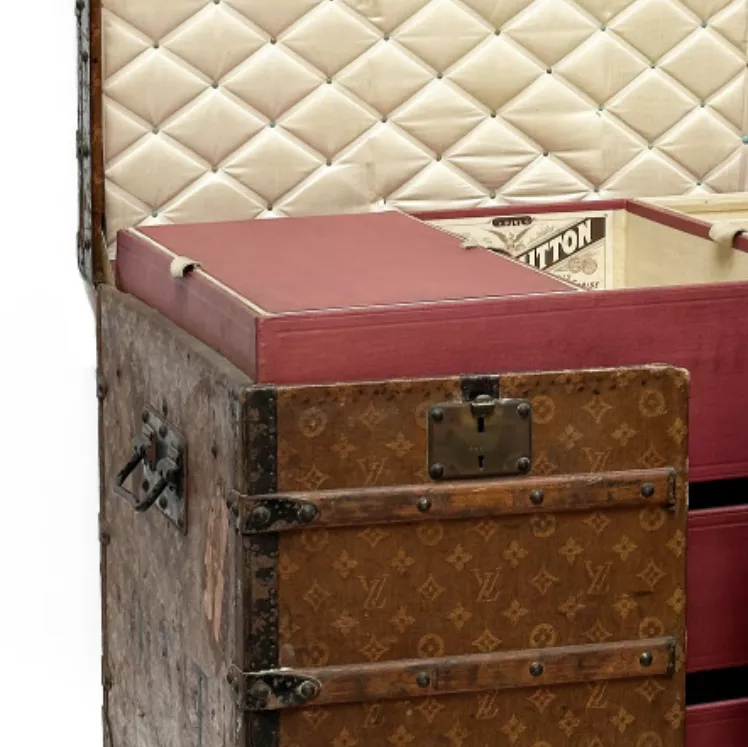
The Vuitton Saga: Four Generations of Luggage Makers
Georges Vuitton, inventor of the Monogram canvas
Georges Vuitton, the founder’s son, took over the company upon his father’s death in 1892 and significantly expanded its international network. It was he who created the Monogram canvas in 1896—a pattern featuring the intertwined initials “LV” accompanied by flowers and diamonds—whose worldwide recognition has never wavered since.
Gaston-Louis Vuitton, Collector and Guardian of the Heritage
Gaston-Louis Vuitton, the founder’s grandson, developed a passion during the early decades of the 20th century for collecting objects related to the art of travel, building an archive and collection of historical artifacts that would become the house’s living memory.
The Transition to the LVMH Era with Bernard Arnault
The company’s integration into the LVMH Group in 1987 under the leadership of Bernard Arnault marked the beginning of a new era of accelerated international growth, without ever compromising its position at the pinnacle of the global luxury market or the artisanal quality of its most demanding creations.
Leadership | Term | Contribution to the House |
Louis Vuitton | 1854–1892 | Founded the company; invented the flat trunk |
Georges Vuitton | 1892–1936 | Monogram canvas, international expansion |
Gaston-Louis Vuitton | 1936–1970 | Archives, Heritage Preservation |
Bernard Arnault (LVMH) | Since 1987 | Global Development, LV Foundation |
The Monogram canvas, originally designed to combat counterfeiting—which had been flourishing since the late 19th century—has, paradoxically, given rise to the most widespread counterfeiting in the history of luxury goods: several hundred million counterfeit Louis Vuitton bags are produced annually worldwide, making the expertise of a professional indispensable for any transaction on the secondary market.
Louis Vuitton's Iconic Prints
1888: The Damier Checkered Pattern
Created in 1888 by Georges Vuitton, the Damier pattern—featuring a chocolate- and beige-colored checkerboard design with the LV initials—is one of the house’s two signature patterns. Discreet and elegant, it continues to adorn some of the most classic styles in the collection.
1896, the Monogram canvas and the LV initials
The Monogram canvas, created in 1896 by Georges Vuitton as a trademark designed to combat counterfeiting, has paradoxically become the most copied symbol in the world; its universal recognition attests to a level of fame unmatched in the history of luxury.
Trianon canvas, Épi leather, and the House’s signature materials
Beyond these two iconic canvases, the House offers a diverse range of materials, from the historic Trianon canvas to the Épi leather with its distinctive striped pattern, as well as the numerous artistic collaborations that have regularly enriched the House’s repertoire of materials.
Canvas | Year of Creation | Distinctive Feature |
Trianon canvas | 19th century | First historical canvas, gray and cream |
Checkered fabric | 1888 | Chocolate and beige checkered canvas, LV initials |
Monogram canvas | 1896 | Flowers and diamonds with LV initials |
Estimate in less than 24h
The brand's iconic trunks and bags
From Mail Trunks to Collectible Cabin Trunks
Louis Vuitton trunks are the most iconic and highly valued category on the pre-owned market, particularly the mail trunks intended for postal shipment and the cabin trunks designed for ocean liner voyages. These pieces, which often have a documented travel history, command very high prices at specialized auctions.
Speedy, Keepall, Noé, and Steamer Bag
The Speedy, created in 1930 at the request of Audrey Hepburn; the Keepall, designed for train travel; the Noé, originally designed to carry five bottles of champagne; and the Steamer Bag are the oldest and most highly valued leather goods models on the secondary market.
Neverfull, Alma, and the Most Sought-After Models
The Neverfull and the Alma—more recent creations that quickly became bestsellers for the brand—are the most liquid items on the Louis Vuitton pre-owned market, with their value directly dependent on their condition and production generation.
Year of Release | Year | Market Demand |
Speedy | 1930 | Very high for the early models |
Keepall | 1930 | High for the leather versions |
Neverfull | 2007 | Structured, fluid design |
Historic Mail Bag | 19th–20th centuries | Very high for documented pieces |
Collectors’ attachment to the brand’s historic pieces also stems from the narrative surrounding each antique trunk or bag: the idea that the piece accompanied its owner on voyages by ocean liner, on the Orient Express, or aboard the first commercial airplanes lends these objects a romantic quality that contemporary pieces cannot match.
Estimate in less than 24h
The Creative Directors Who Reinvented Louis Vuitton
Marc Jacobs and the Birth of Ready-to-Wear
Marc Jacobs’ arrival as creative director in 1997 marked a decisive turning point in the house’s history, as it launched its first ready-to-wear line and opened itself up to the most unexpected artistic collaborations. This period, which lasted until 2014, produced some of the most sought-after pieces on the Louis Vuitton vintage market.
Nicolas Ghesquière, Virgil Abloh, and Pharrell Williams
Nicolas Ghesquière, who succeeded Marc Jacobs in 2014, followed by Virgil Abloh for the men’s line and Pharrell Williams since 2023, each demonstrate in their own way the brand’s ability to blend heritage with modernity, attracting new collectors with every creative transition.
Artistic Collaborations: Murakami, Kusama, Supreme
The brand’s artistic collaborations with Takashi Murakami, Yayoi Kusama, and Supreme have produced limited-edition pieces whose resale value on the secondary market frequently exceeds their original retail price, as the artistic merit and rarity of these items combine to drive up their value.
Creative Director | Period | Contribution |
Marc Jacobs | 1997–2014 | Ready-to-wear, artistic collaborations |
Nicolas Ghesquière | Since 2014 | Modernity and innovation in materials |
Virgil Abloh | 2018–2021 (men’s) | Streetwear and popular culture |
Estimate in less than 24h
The Louis Vuitton Foundation, a showcase for art designed by Frank Gehry
A contemporary art museum that opened in 2014 in the Bois de Boulogne
Inaugurated in 2014 in the Bois de Boulogne, the Louis Vuitton Foundation is one of the LVMH Group’s most ambitious architectural and cultural projects. This contemporary art museum, whose permanent collection and temporary exhibitions attract visitors from around the world, contributes to the brand’s cultural influence far beyond the realm of luxury alone.
A glass architecture designed by Frank Gehry
The spectacular architecture of the Louis Vuitton Foundation, designed by renowned architect Frank Gehry, features a composition of twelve curved glass sails forming a structure reminiscent of a ship or an iceberg. In just a few years, this building has become one of the most photographed cultural destinations in Paris.
Exhibitions, Collection, and Philanthropy: Planning Your Cultural Visit to Paris
The Foundation offers a rich cultural program, combining exhibitions from the permanent collection with temporary exhibitions dedicated to the biggest names in contemporary art. Visits must be booked online via the Foundation’s official website; the museum is located in the Jardin d’Acclimatation in the Bois de Boulogne.
The Louis Vuitton Foundation welcomes several million visitors each year, making it one of the most visited museums in the Paris region.
This cultural appeal indirectly helps maintain the brand’s exceptional reputation among a diverse international audience, some of whom may go on to become potential buyers in the secondary market.
How to Authenticate a Louis Vuitton Bag or Trunk
Date code, serial number, and stamp
Every Louis Vuitton bag bears a date code—a two-letter, four-digit code introduced in the 1980s that identifies the date and place of manufacture. Historic trunks bear an engraved or hot-stamped hallmark identifying the house and the address of the original workshop.
Stitching, photogravure, and quality of the coated canvas
The quality of the stitching, the precision of the photogravure of the Monogram or Damier pattern, and the consistency of the coated canvas are additional technical authentication criteria that enable experts to identify the numerous counterfeits circulating in the secondhand market.
Provenance, craftsmanship, and original documentation
Documented provenance, the official store receipt, and original documentation are the additional guarantees most highly valued by potential buyers.
Element | Significance | Impact on Value |
Date code | Date and manufacturing location code | High |
Stamp (trunks) | Engraved mark identifying the manufacturer | Very high for historic trunks |
Stitching and canvas | Quality of craftsmanship | Decisive |
Beyond the technical identification of the markings, the expert also assesses the consistency between the date indicated by the code and the model presented—since certain models were only produced starting in a specific year—as well as the consistency between the indicated country of manufacture and the piece’s stylistic characteristics.
These cross-checks make it possible to eliminate the vast majority of forgeries, even though their technical sophistication continues to advance.
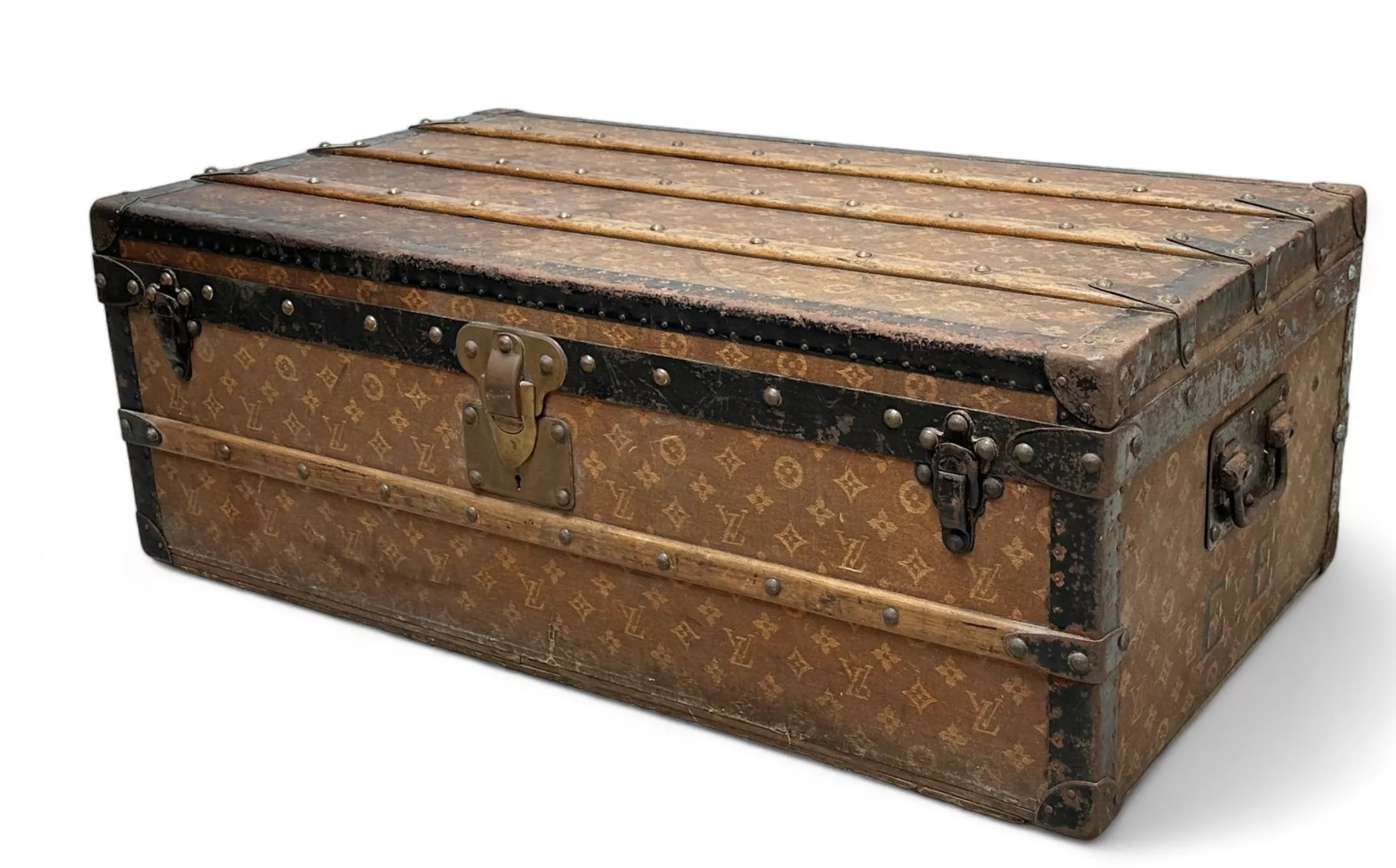
What Determines the Value of a Louis Vuitton Item
Rarity, limited editions, and collaborations
The rarity of an item—particularly when it is a limited edition produced in collaboration with an artist—is the primary factor determining its value, as these items can significantly exceed the retail price at specialized auctions.
Condition and Completeness (keys, padlocks, dust bag)
The condition of the leather or canvas, and the completeness of the item—including keys, padlocks, dust bag, and original receipt—are major valuation criteria directly factored into the estimate.
Iconic Model and Market Demand
The specific model and the strength of current demand for this item in the luxury secondhand market ultimately determine the final valuation.
Type of item | Approximate price range |
Speedy 30 bag in Monogram canvas | 400 to 1,200 euros |
Historic Louis Vuitton Mail Trunk | 3,000 to 30,000 euros |
Limited-edition artistic collaboration | 1,500 to 15,000 euros |
Ultimately, appraising a Louis Vuitton piece requires specific expertise that involves simultaneously identifying the exact model, dating it based on the manufacturing code, examining the quality of the canvas or leather, and verifying that all original accessories are included. Auctie’s is committed to providing this expert analysis in every estimate it issues.
Get a Free Appraisal of Your Louis Vuitton Items
Auctie's offers all owners of Louis Vuitton items a free appraisal service, conducted by a state-certified auctioneer, within twenty-four hours.
A certified appraisal by a licensed auctioneer within 24 hours
This appraisal is based on a review of detailed photographs of the item, including the date code and the overall condition of the canvas or leather.
Free appraisal in less than 24 hours Trust Auctie's to appraise your Louis Vuitton items: a certified response within 24 hours, with no obligation and complete confidentiality. |
Photos and information needed for a reliable online appraisal
To help the expert provide an accurate estimate:
Clear photographs of the item from multiple angles
A photo of the date code or stamp
The overall condition of the canvas, leather, and hardware
Any original accessories included: keys, padlocks, dust bag, receipt
Sell Your Louis Vuitton Items at Auction with Auctie's
From the reserve price to the final bid: Aiming for the Best Price
The auction begins with setting a reserve price consistent with the initial estimate.
Hôtel Drouot and online auctions: reaching the right collectors
The reputation of Hôtel Drouot, combined with the growth of online auctions, allows us to reach an international audience of collectors who are particularly drawn to historic trunks and the rarest artistic collaborations.
“Auctie’s appraised and then sold a Louis Vuitton trunk I inherited from my great-grandmother, providing a very precise assessment of its age and the condition of the canvas.”
Customer testimonial, sale conducted by Auctie’s.
Inheritance, Moving: What to Do with Inherited Louis Vuitton Items?
Inventory and Distribution of an Inherited Collection
Taking inventory of an inherited Louis Vuitton collection is an essential first step before dividing the estate among the heirs.
Sell, Keep, or Pass On After an Inheritance
Once the inventory is complete, several options are available to the heirs. Auctie’s guides this decision-making process without ever pressuring you into a hasty decision.
Confidentiality of the process and seller anonymity are preserved
Auctie's guarantees each owner absolute confidentiality throughout the entire process.
Glossary of Louis Vuitton and the Luggage Maker
Term | Definition |
Trunk Maker | A craftsman specializing in the manufacture of travel trunks |
Monogram Canvas | Canvas featuring the interlocking LV motif, created in 1896 |
Damier Canvas | Chocolate and beige checkered canvas, created in 1888 |
Date code | Date and manufacturing location code stamped inside the bags |
Mail trunk | Trunk intended for postal shipment |
Limited edition | Produced in limited quantities, often in collaboration with artists |
Provenance | Documented history of a piece’s successive owners |
Auction | Final award of the item to the highest bidder |
Reserve Price | Starting price set for the opening of the auction |
Estimate in less than 24h
Let Auctie's appraise your Louis Vuitton items
Free appraisal in less than 24 hours Auctie's, a licensed auctioneer, will appraise your Louis Vuitton bags, trunks, and other items for free in less than 24 hours, with complete confidentiality. |
Discover in the same theme

Auctioneer in Pays de la Loire: Valuation – Aucties
Have your artwork, jewelry, and collectibles appraised in the Pays de la Loire region by Aucties experts. 100% free online appraisal.
Learn more >

Auctioneer in Occitanie: Valuation – Aucties
Have your artwork, jewelry, and collectibles appraised in Occitanie by Aucties experts. 100% free online appraisal within 24 hours. ✅
Learn more >

Auctioneer Perpignan: Art Valuation | Aucties
Have your artwork, jewelry, and collectibles appraised in Perpignan by the experts at Aucties. 100% free online appraisal within 24 hours. ✅
Learn more >

Secure site, anonymity preserved

Auctioneer approved by the State

Free and certified estimates
Frequently asked questions
-
What factors influence the value of a Louis Vuitton item at auction?The value of a Louis Vuitton item depends primarily on the model, the collection, its condition, and its age. Historic trunks with documented provenance, models created by the most prestigious artistic directors, and limited editions resulting from artistic collaborations (Murakami, Kusama, etc.) command particularly high prices. Authenticity is also crucial, as widespread counterfeiting makes expert appraisal indispensable.
-
How can you authenticate a Louis Vuitton item before selling it?We recommend that you submit your item for a free appraisal at Auctie's. Our state-certified auctioneers and specialized experts will assess the authenticity, condition, and market value of your item. The appraisal is non-binding, and you’ll receive a response within 48 hours.
-
Is this the right time to sell a Louis Vuitton item?Yes, the Louis Vuitton secondary market remains dynamic and robust, particularly for vintage pieces, iconic models (Speedy, Keepall, courier trunks), and limited-edition artistic collaborations. Items in good condition enjoy stable demand, and historic trunks with documented provenance regularly fetch very high prices.
-
How does the appraisal of a Louis Vuitton item work at Auctie's?The appraisal is completely free and non-binding. Simply send us photos and a description of your item. An expert specializing in luxury leather goods and luggage will examine it, verify its authenticity, and determine a price range based on comparable items on the market. You’ll receive our assessment within 48 hours.
-
How does the auction of a Louis Vuitton item work at Auctie's?Once the appraisal is accepted, Auctie's supports you every step of the way: professional cataloging of your item, targeted promotion to collectors, preparation for the specialized sale, and management of the auction. You receive the proceeds from the sale after fees are deducted. Our experts are well-versed in the world of Louis Vuitton and know how to attract the most discerning buyers.
