



Exceptional discovery of a Cinquedea-type noble sword
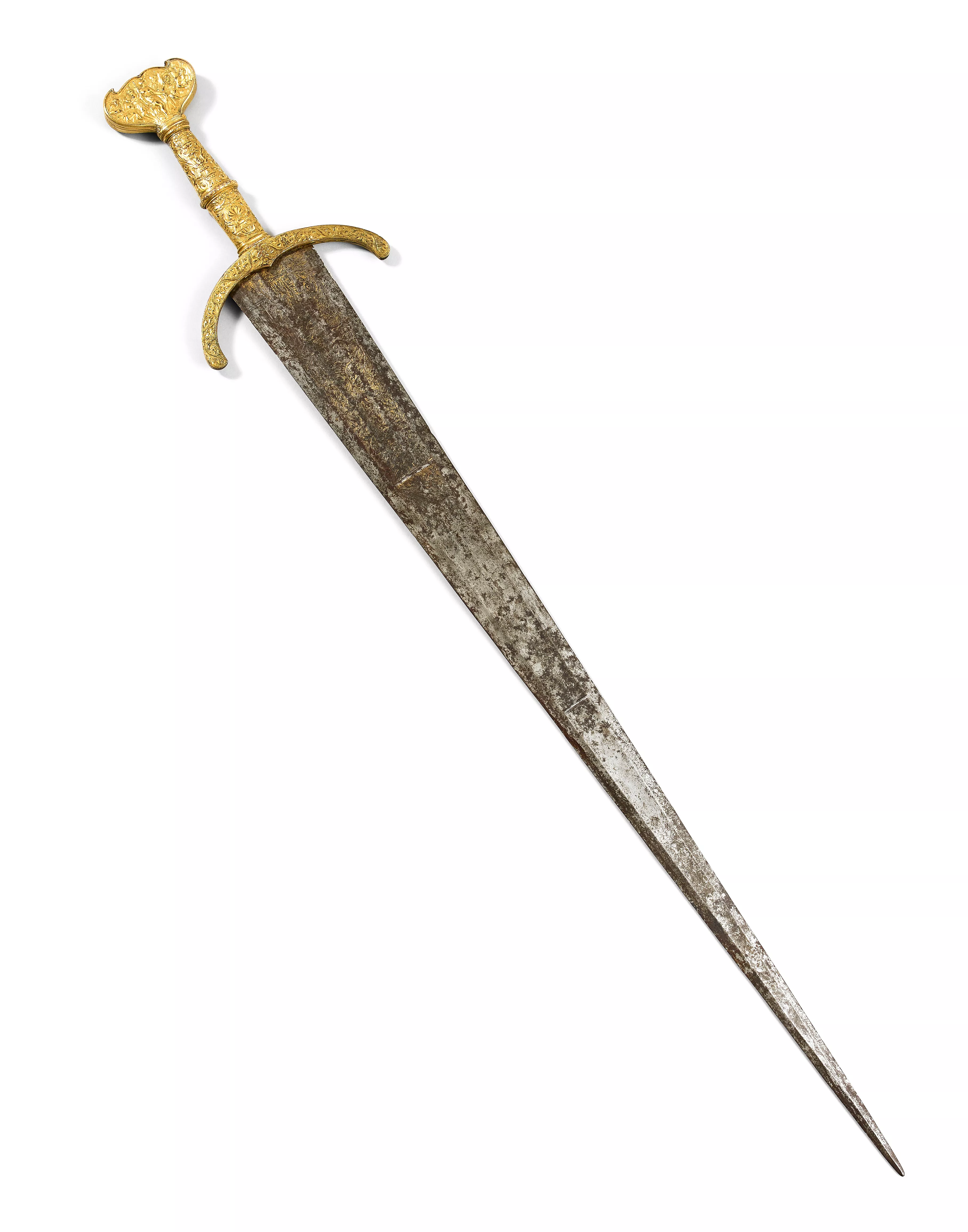
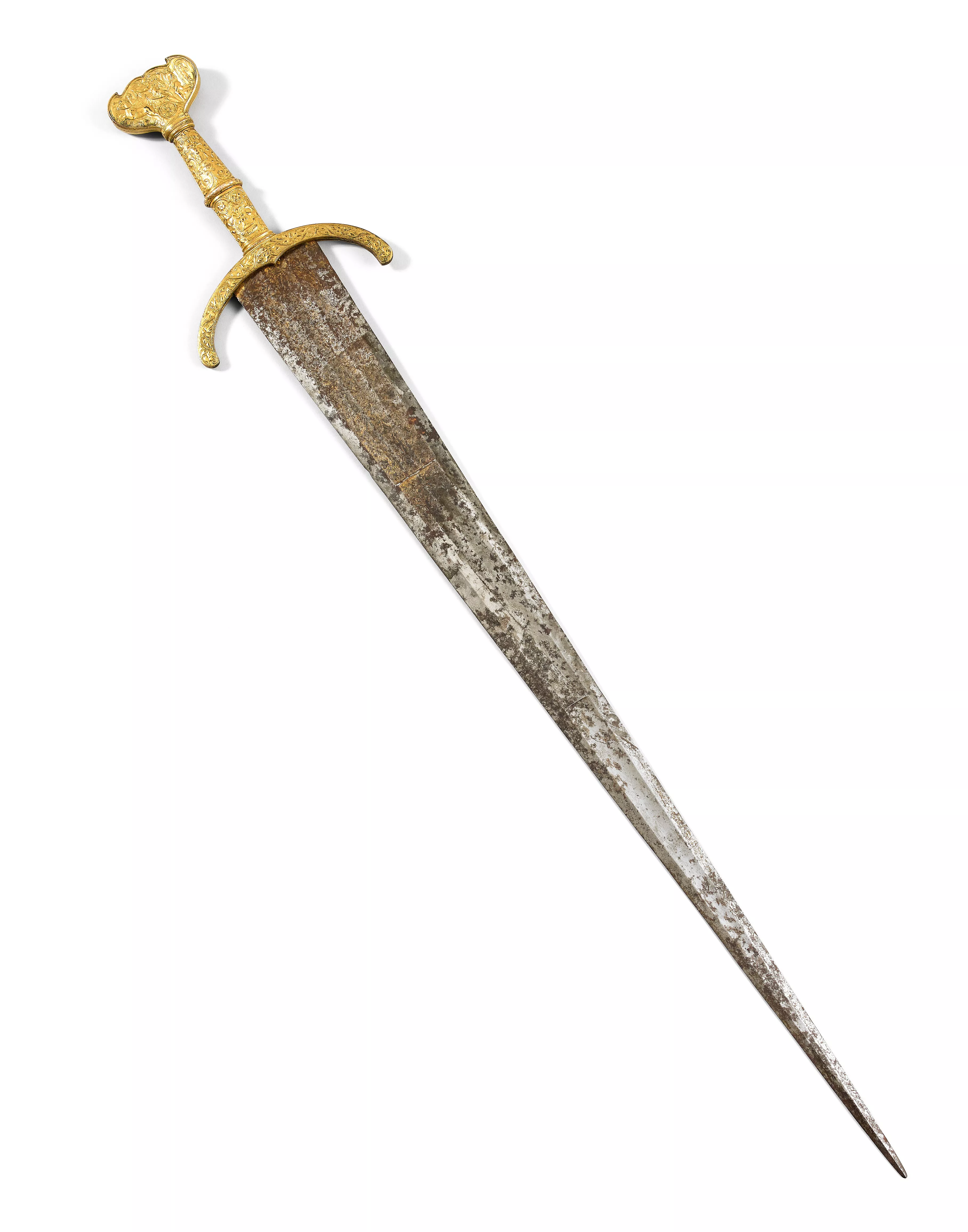
Live with us the discovery of an exceptional sword dated between 1490 and 1510 (Florence) of the Cinquedea type, sold on March 31st at Drouot
.
On March 31, 2023, a rare find will be honored and then sold under the hammer of Maître Béral at Drouot. This Cinquedea-type noble present or ceremonial sword has been authenticated, from a private individual residing in France.
This lot has been authenticated by Auctie's team and Antique Weapons expert, Alban Degrave, 06 59 66 40 40.
To make an appointment to see this sword in preview, click here.
Work attributed to northern Italy circa 1490-1510
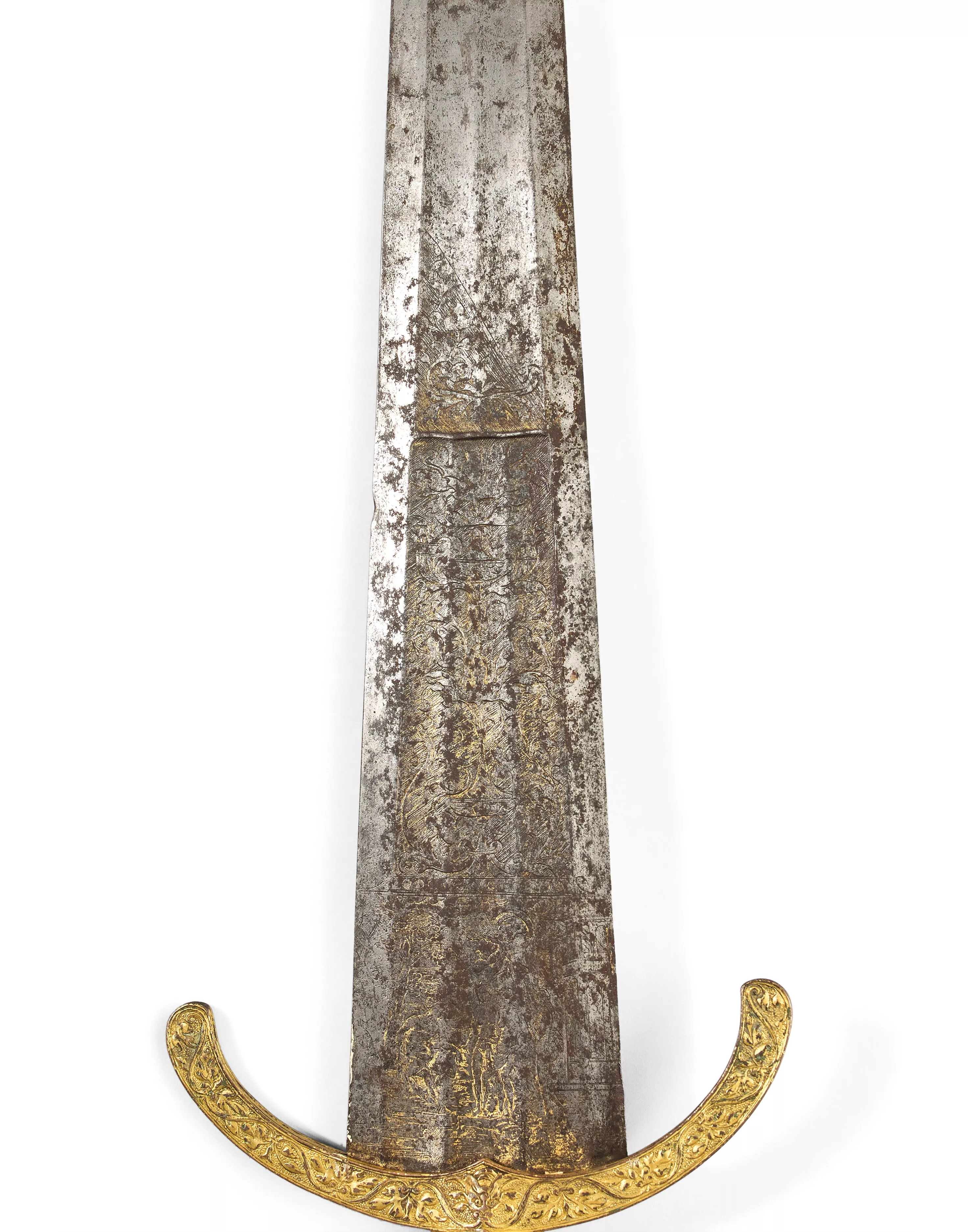
The engravings on the blade are similar to those produced in the workshop of the iron silversmith Ercole dei Fedeli active in the late 15th and early 16th centuries. Close to the circles of Italian power, notably Isabella d'Este and the court of Mantua, it is essentially his production as a "sword engraver" that is known to us, characterized by figures moving in complex antique-style architectural spaces, figures in medallions added with rinceau and grotesques.
Global typology
From a typological point of view, the sword is similar to the cinquedea, a short ceremonial sword with a flat triangular blade punctuated by fluting. Worn exclusively in civilian clothes, it enjoyed a brief heyday with Italian Renaissance princes at the turn of the 15th and 16th centuries. The blades were often richly decorated with ornamental motifs in vogue at the time, as well as allegorical and mythological scenes intended for a refined and cultured public able to perceive their meaning.
If we refer to the specimen preserved at the Louvre Museum (inv. MRR 58), the one at the Metropolitan Museum of Art in New York (inv. 14.25.1172) or Cesare Borgia's sword preserved at the Casa Caetani. It seems that there may have been a rare production of similar weapons in elongated versions.
We read in Eugène Muntz's "Les épées d'honneur distribuées par les papes", 1895.
"The pope offered "swords of honor" every year, and they are characterized by: works of art in the full force of the term: chasing, damascening, enameling, struggled with finish and elegance; scrolls of exquisite taste alternated with subtle allegories or inscriptions in beautiful Ciceronian Latin. And first of all let us point out the originality of their form and ornamentation: these weapons were intended to be held with both hands, the point in the air..."
Ewart Oakeshott classifies the blade as type XXI.I and the guard as type IX "Appears typically fifteenth-century despite some examples known as early as the thirteenth. The arms form like a ribbon that would be perpendicular to the plane of the blade."
The mount
Materials
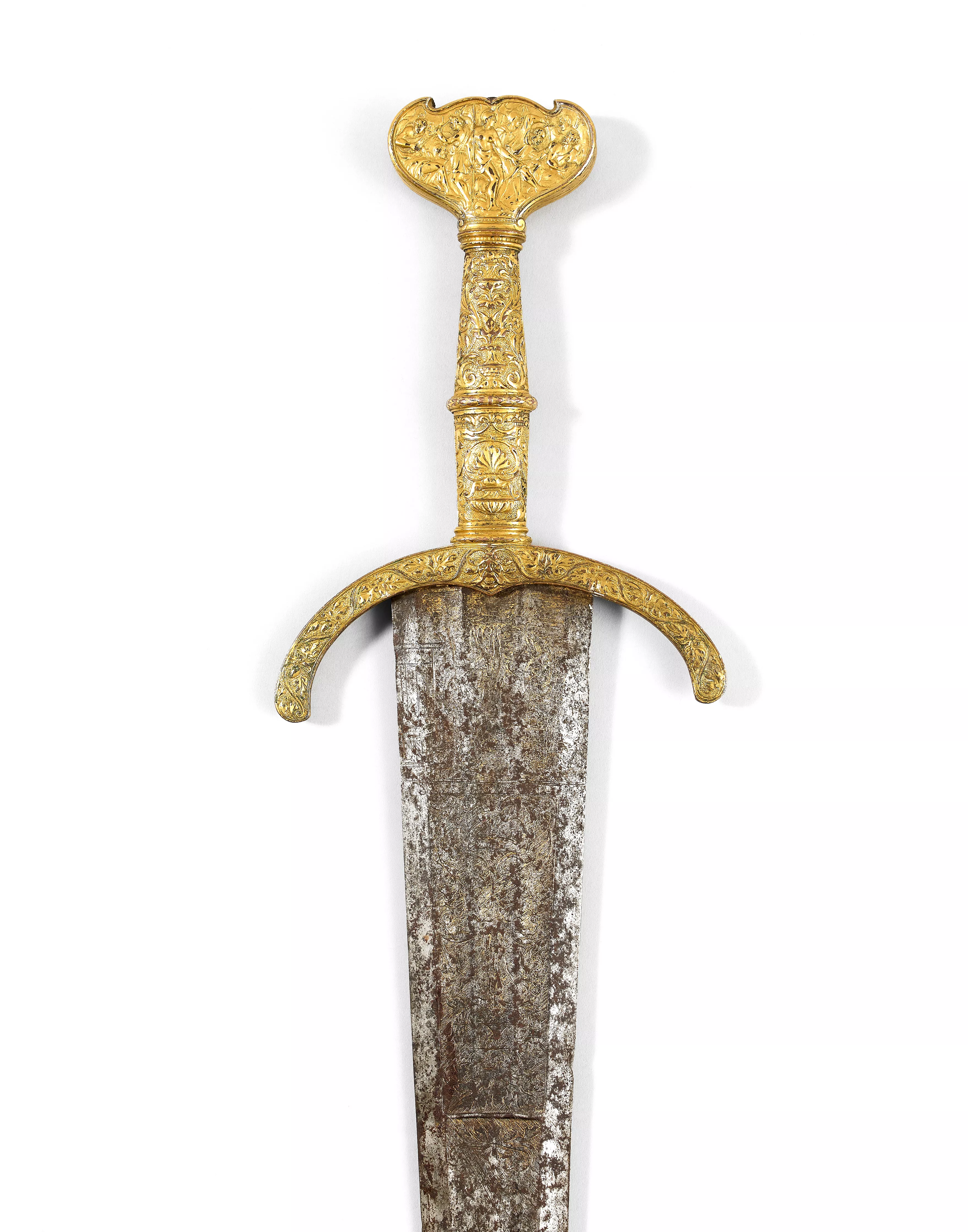
Copper and gilt bronze.
The pommel
River knob visible at its top. A cartouche consisting of two repoussé, chased and gilded cerite bronze plates in a gilded bronze belt.
On one side, figure Minerva at the center of a combat.
On the other, Victoria or Niké on the triumphal chariot with the eight-branched solar wheel, preceding Renommée sounding her trumpet.
- Related work:
Present in the collections of the National Gallery of Art Washington on a cartouche sword pommel plate a depiction of the Judgment of Paris NI:1942.9.207.
Scene we will find engraved on the blade of our sword.
- Symbolism:
Minerve, goddess of high thought and war waged through strategy. Fama, goddess of fame, making heroes immortal, never letting their memories die.
The Roman triumph is a Roman ceremony in which a parade is held in which the victorious general is paraded on a chariot at the head of his troops.
The solar wheel with four axes and eight branches is a symbol of sacred division of space and time.
Associated with the triumphal chariot, it may represent temporal power.
We may think that the recipient of this work of art experienced a battle that he won thanks to his strategic skills, offering him a position of power in the city and triumph in his victory.
The rocket
In gilded copper.
Made of two halves held in the center by a laurel wreath ring. The two ends are held embedded in the pommel and hilt. It features a candelabra and bucranium decoration.
- Related works:
The same type of composition can be found in an engraving printed in Florence dating from 1470-1490 reproduced in the book Les premières gravures italiennes by Gisèle Lambert.
It is preserved at the BNF, Florence, Ornements, Cat 216-276.
"Burin en manière large" 262X46. Circa 1470-1490.
- Symbolic:
The bucranium is a canonical ornamental motif of the ancient Doric order revived from the Renaissance onwards evoking the remains of animals sacrificed in honor of the gods. It should be noted that the Doric order was often associated with heroic figures and male deities in the Renaissance, thanks to the writings of the Roman architect Vitruvius. This may explain the choice of this motif on the hilt. Such weapons were intended for an erudite public and were meant to display this erudition.
The guard
In assembled copper plates, chased and gilded.
Two quillons bent into a half-moon shape, a slight asymmetry that can be found on Caesar Borgia's sword, preserved in the Bargello museum as well as on the one in the Louvre museum.
In the center a grotesque decoration and friezes of vine leaves on the branches.
Related work:
Sword, circa 1500/1600 Musée du Louvre MRR 58; P 280 303.
The blade
A double-edged triangular shape. It has three grooves at the heel, two in the center and one in the last third. Reinforced pierced point.
Presence of a forge mark.
The engravings
Highlighted in gold, they extend from the heel to a third of the blade.
The most notable feature is the presence on one side of an important scene depicting the judgment of Pâris. In this famous mythological episode prefiguring the Trojan War, the Trojan prince Paris is entrusted by Jupiter with the task of choosing the most beautiful of the goddesses from among Juno, Minerva and Venus, in the context of a conflict between them following the scheming of the goddess of Discord. Taken by Mercury to the top of a mountain, Paris bestows the golden apple on Venus, who promises him the hand of the most beautiful woman in the world, Helen, wife of the Spartan king Menelaus, an event that will precipitate Greece into war.
The scene shows the young prince in heroic nudity, the apple of Discord in his hand, seated before the three equally naked goddesses. The scene is framed by an "antique-style" architectural structure on the right and a wood on the left. The overall composition is reminiscent of the lost work by Raphael (1483-1519), known from engravings made by Marcantonio Raimondi (1480-1534) as early as 1514.
The "Judgment of Paris" was a recurring motif during the Renaissance, a period in which a new humanist culture flourished, drawing its references from the ancient Greco-Latin heritage. The subject was imbued with a complex and sometimes gallant philosophical symbolism, a pretext for the exhibition of naked bodies. It is regularly present in the field of European weapons and armor intended for pageantry, as can be seen on a cinquedea in the collections of the Musée de l'Armée in Paris (inv to be specified). These weapons, often the fruit of gifts, were decorated to delight the senses and show off refinement, culture and even the ability, real or imagined, to grasp hidden messages. It is therefore not insignificant to find it on such a blade.
On the other side, near the heel, in a medallion, is the profile of a laurelled head emperor beneath a candelabra flanked by two putti, the whole surmounted by a nude female figure, logically Venus if we refer to the general iconography of the blade, the one designated as the most beautiful by Pâris.
On both sides of the blade, the engraving stops at a bevel, another characteristic of cinquedeas on which an asymmetry of decoration is often to be noted.
Dating and location
The dating and location of this piece are established in this notice from the elements we have at our disposal, leading us to the conclusion of a strong probability for a late 15th, early 16th century Northern Italian production.
Technical data
Blade length: 86 cm.
Overall length: 106 cm.
Balance point: 15 cm.
Weight: 1330 grams.
Oxidations.
Acknowledgements
We would particularly like to thank Mr. Philippe Malgouyres, Chief Curator of Heritage at the Musée de Louvre, for having been kind enough to receive us in order to discuss this sword.
Inscrivez-vous avec votre adresse e-mail afin de recevoir les catalogues de nos futures ventes
