



An exceptional Vincennes porcelain dish from the Louis XV service pre-empted by the Château de Versailles

Key takeaways
- Large oval dish made of Vincennes porcelain from 1755, part of the “Bleu Céleste” service commissioned by Louis XV, purchased by the Palace of Versailles on April 18.
- An exceptional piece that cost 840 livres upon delivery; it is the only known example preserved in France among the four large oval platters from the original service.
- Impressive dimensions of 60.5 cm in length, making it the largest piece in the service and a technical feat of the Royal Porcelain Manufactory of Vincennes.
The auction house Auctie's is honored to announce the pre-emption this April 18 by the Château de Versailles of an exceptional large oval dish in Vincennes soft porcelain, from the "Bleu Céleste" service of King Louis XV at the Château de Versailles. It will therefore be exhibited in the place for which it was created.
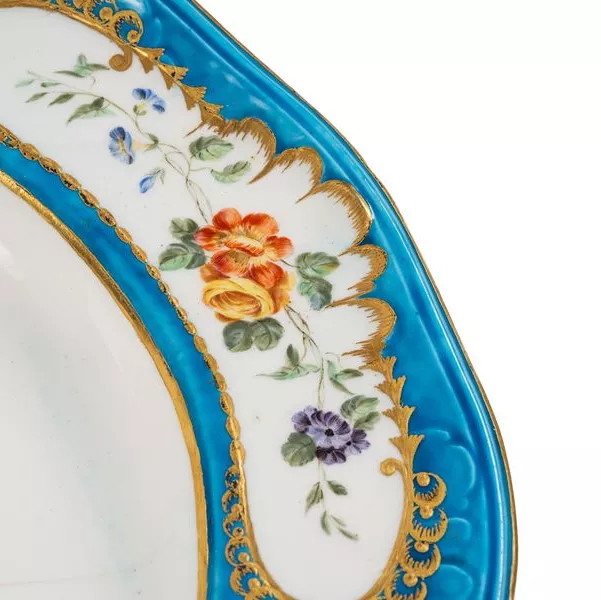
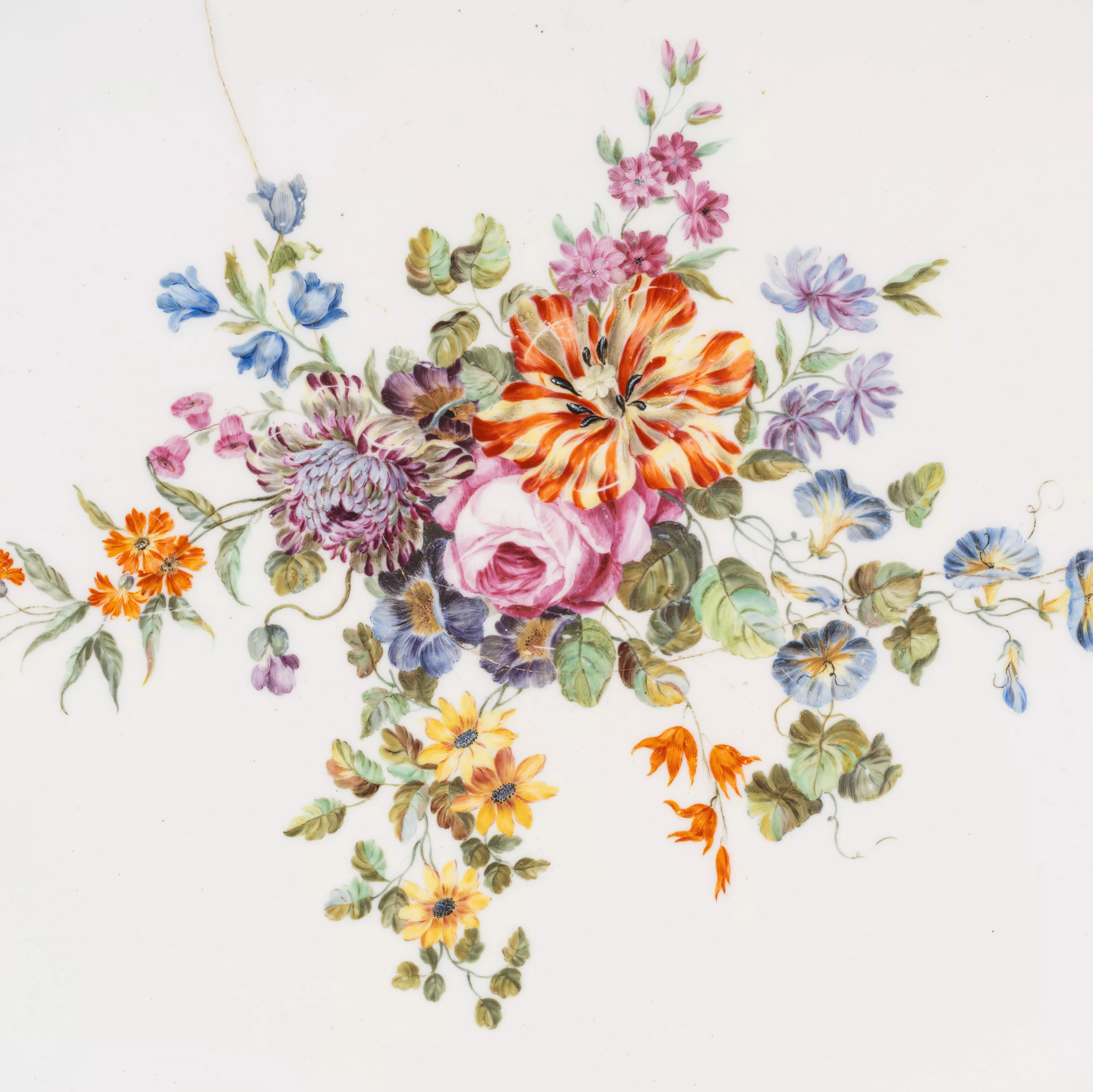
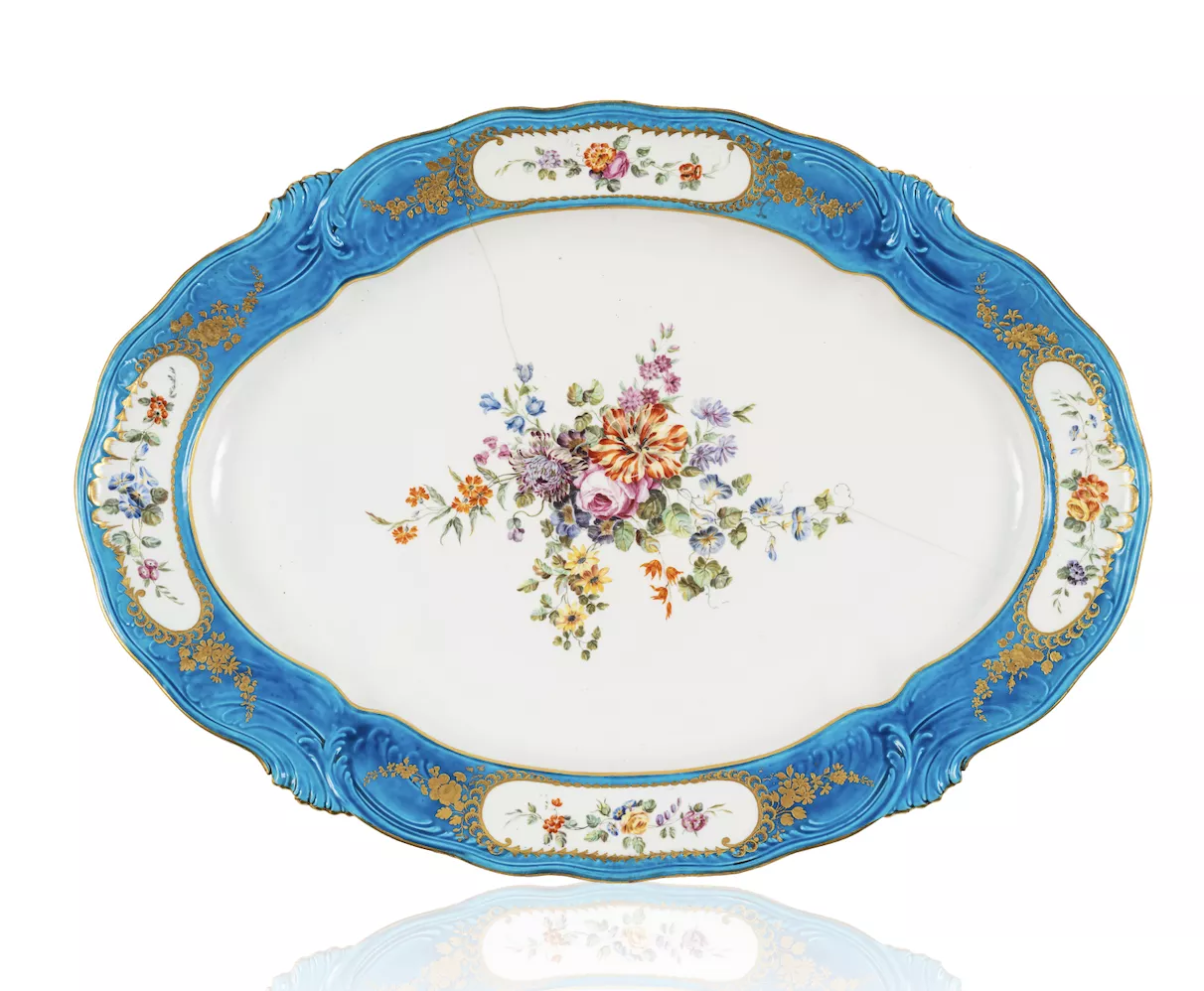
Large oval dish in soft-paste porcelain, with contoured edges formed by generously ribbed palms in relief after the model of Jean-Claude Duplessis (1699-1774), with polychrome decoration in the center of a group of flowers and on the edge of garlands of flowers and foliage in four reserves encircled by threaded sequins, combed, rose thorns and garlands of flowers in gold on a celestial blue background, gold fillet on each border. A large crack formerly restored with staples.
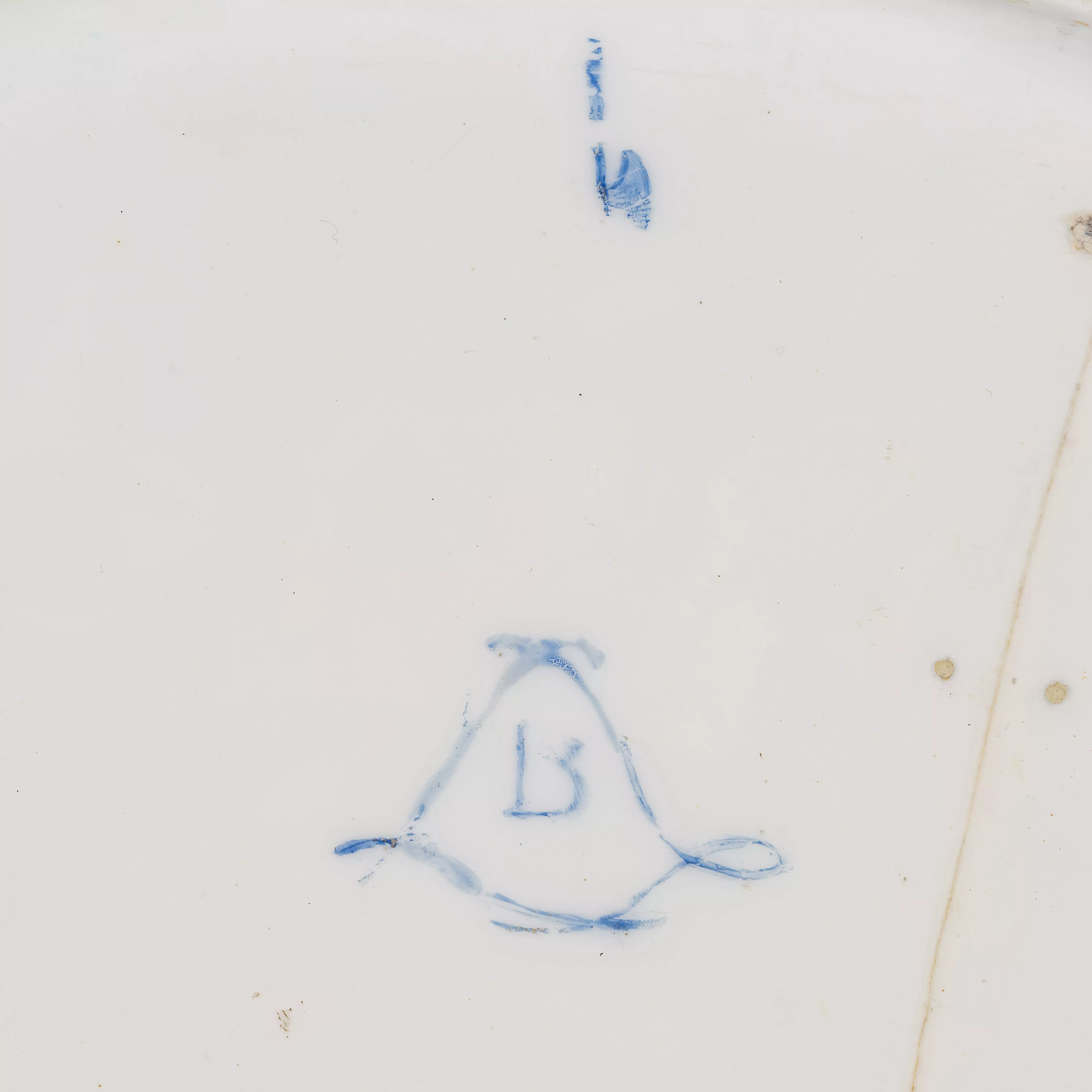
Royal Manufactory of Vincennes, 18th century, 1755. Mark in blue with interlaced LL, letter-date B for 1755; mark in blue of flower painter Pierre-Joseph ROSSET dit l'Aîné (active 1753-1795). W. 60.5 x D. 44.5 x H. 6.5 cm. Provenance - Louis XV, King of France and Navarre (1710-1774), at the Château de Versailles. - Most likely mentioned in 1778 in the Offices of the Petit Trianon château, owned by Queen Marie-Antoinette (1755-1793), among "3 large oval dishes". - French private collection.
History
Louis XV's "bleu céleste" service was the first complete dinner service to be delivered by the new Royal Manufactory at Vincennes, i.e. comprising all the "French porcelain" pieces required for all meal services including fruit. It was ordered by the King from the manufactory in 1751 for the Château de Versailles.
Delivered in three installments in 1753, 1754 and 1755, it comprises 1759 pieces (493 pieces for the table service and 1266 pieces for the main service, mostly in cookie), some of which feature new shapes created especially for the King by his goldsmith Jean-Claude Duplessis (Turin, 1699-Paris, 1774). Costing a total of 87,272 livres, this service uses a color that is also new, created in 1753 by Jean Hellot (1685-1766), director of the Académie des Sciences and recently attached to the Manufacture royale.
Related to Egyptian blue and much appreciated on Chinese porcelain from which it derives its name of celestial blue, also named Bleu Hellot or bleu ancien or bleu du Roi, this intense turquoise blue could only be used dry on a mordant and not with a brush. It is a ground color.
The first part of the service, delivered on December 24, 1753, was exhibited to the public in Paris at the merchant Lazare Duvaux, rue Saint Honoré. On April 8, 1754, the Manufacture de Vincennes paid Mr. Le Prince the sum of 52 pounds worth of candles that had been given to Mr. Duvaux to light the room where the service du Roy was displayed (arch. Sèvres, Vf2). On April 2, 1754, Duvaux received the sum of 430 livres, 11 sols et 6 deniers for various expenses, including the transport of porcelain to Versailles, as well as for showing the King's service to the public.
The first part of the service was in fact sent by the merchant to Versailles at the beginning of February 1754. The Duc de Croÿ relates in his diary on February 11, 1754, that after a dinner at Versailles, "Louis XV kept us busy unpacking his beautiful service, blue, white and gold, from Vincennes, which we had just sent back from Paris, where it had been displayed for the eyes of connoisseurs, It was one of the first masterpieces of this new porcelain manufacture which claimed to surpass and bring down that of Saxony.
The Marquise, to whom the King had given the village of Sèvres, had very extensive work done, at the King's expense, to establish it there alongside the glassworks. There were some charming pieces of this service, more pleasant than usual. The paste and the white seemed to me very beautiful and close to Japan". (Vicomte de Grouchy and Paul Cottin, Journal inédit du Duc de Croÿ (1718-1784), 1906, I, pp. 230-231).
The second and third deliveries of the service took place on December 31, 1754 and then December 31, 1755. The "Service en Bleu céleste livré au Roy" included four "Grands plats ovales" including ours, mentioned at the top of the list during the last delivery on December 31, 1755, each at the impressive price of 840 livres, making it the most expensive dish in the service, on a par with the large round dishes (arch. Sèvres, Vy1 f° 119 v°).
Before the discovery of our dish, we knew of only two of these four large oval dishes, preserved in the collections of His Grace the Duke of Buccleuch at Boughton House (England). One of these two dishes was unfortunately formerly broken into several pieces and is mounted in bronze on a pedestal table.
Of the same dimensions and decoration, they are also similarly marked with the letter-date B for 1755, but have another painter's mark, a G probably for Jean-Baptiste Etienne Genest.
We know of our painter Pierre Joseph Rosset (1734-1799) in particular another dish from the service, a 2nd size rôts dish, recently purchased by the Château de Versailles (Sotheby's sale, London, May 22, 2019, lot 446).
The large oval dish we present is thus the only known one preserved in France, the fourth dish being to date lost and none previously appearing on the art market.
The Marquise, to whom the King had given the village of Sèvres, having very great work done, at the King's expense, to establish it there next to the glassworks. There were some charming pieces of this service, more pleasant than usual. The paste and the white seemed to me very beautiful and close to Japan". (Vicomte de Grouchy and Paul Cottin, Journal inédit du Duc de Croÿ (1718-1784), 1906, I, pp. 230-231).
The second and third deliveries of the service took place on December 31, 1754 and then December 31, 1755. The "Service en Bleu céleste livré au Roy" included four "Grands plats ovales" including ours, mentioned at the top of the list during the last delivery on December 31, 1755, each at the impressive price of 840 livres, making it the most expensive dish in the service, on a par with the large round dishes (arch. Sèvres, Vy1 f° 119 v°).
Before the discovery of our dish, we knew of only two of these four large oval dishes, preserved in the collections of His Grace the Duke of Buccleuch at Boughton House (England). One of these two dishes was unfortunately formerly broken into several pieces and is mounted in bronze on a pedestal table.
Of the same dimensions and decoration, they are also similarly marked with the letter-date B for 1755, but have another painter's mark, a G probably for Jean-Baptiste Etienne Genest.
We know of our painter Pierre Joseph Rosset (1734-1799) in particular another dish from the service, a 2nd size rôts dish, recently purchased by the Château de Versailles (Sotheby's sale, London, May 22, 2019, lot 446).
The large oval dish we present is thus the only known one preserved in France, the fourth dish being to date lost and none previously appearing on the art market.
A large part of the service, around 140 pieces, was sold in July 1757 by Louis XV to Etienne-François de Choiseul, comte de Stainville-Beaupré (future duc de Choiseul-Stainville in 1758), then French ambassador to Vienna, through Lazare Duvaux, but no dishes from the service were sold by the King. Many of these pieces are now at Boughton House. The part of the service that remained in the Crown's collections is mentioned in an "État des Porcelaines de Sèvres déposées dans les Offices du Château du Petit Trianon" drawn up on June 16, 1778 and preserved in the archives nationales (AN K506, no. 21), mentioning the presence of numerous dishes, including "3 large oval dishes for the large pieces, one of which is broken". Apart from the fact that one of the four dishes delivered in 1755 is missing, it would be pleasant to imagine that the broken dish is ours, our dish probably being part of this set of three in the same way as the two dishes preserved at Boughton House.
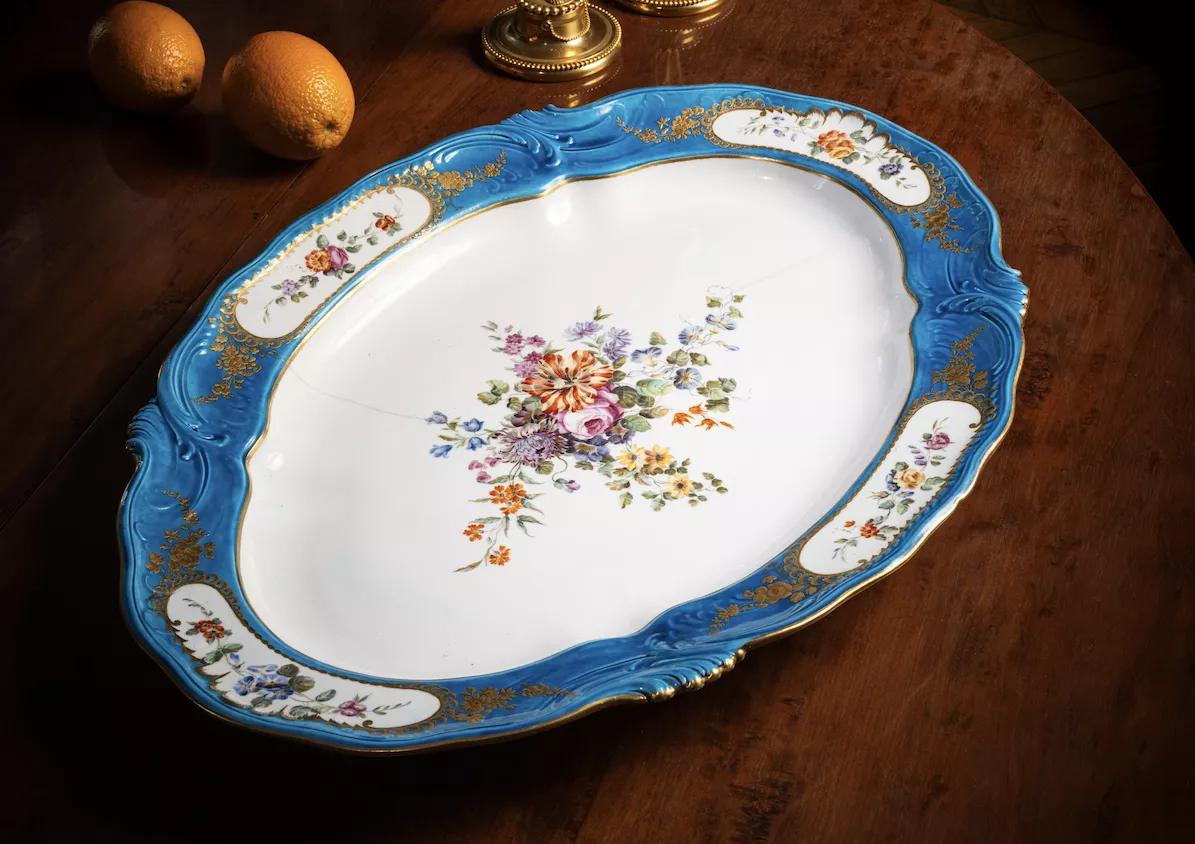
The result of a veritable technical feat, our dish is exceptional for the quality of its workmanship and in particular the relief of its ribs, its brilliant, transparent glaze, the depth of its blue, but above all for its size, since it is the largest dish, and indeed quite simply the largest piece in the service.
Antoine d'Albis, chemist and former head of the laboratory at the Manufacture de Sèvres, has measured the importance of these large oval dishes in the history of porcelain through two articles in which the Boughton House dishes are cited and we learn more about their incredible manufacture: - "Another technical feat dating from the same period as the Naiad is represented by the two large oval dishes with "celestial blue" backgrounds from Louis XV's service, delivered on December 31, 1755 and preserved today in the Duke of Buccleuch's collection at Boughton House.
Their size is impressive: 60.4 cm long and 44.5 cm wide. This means that before the drying and firing shrinkage, the length was almost 70 cm and the width 51 cm. Almost anything could be made with soft porcelain, except large pieces.
The raw breakage must have been considerable, and surviving pieces are few and far between. One has to admire the practitioners of the time, who couldn't have created a larger piece. Indeed, the refractory boxes or "gazettes" used in the decor firing pass-through kiln, in which the dishes were to be placed, had the following dimensions: length 78 cm, width 48 cm and height 40 cm.
While these 60 cm dishes fitted easily into the cases lengthwise, their width of 44.5 cm meant that they had to be loaded obliquely to fit into the cases, which were too small, as they were only 40 cm high, and had to be lined with a refractory plate.
To hold them in this way, metal supports called "lecterns" were used. The dishes had to be fired at least seven times, twice for the celestial blue, three times for the polychrome decoration and twice for the gilding. All the odds were stacked against the pieces shattering or, on the contrary, devitrifying! There must have been multiple failures.
Like the Naïade, these two dishes are extremely rare pieces, because they were so difficult to make that very few were made. (...) At Vincennes-Sèvres, as a rule, technical feats are never seen, and it was appropriate here to recall their existence." (A. d'Albis, "La Naïade du musée du Louvre. Entre éclatements et dévitrifications", in Revue du Louvre, n° 1, 2020, p. 61 and ill. 8). -
" The most spectacular is undoubtedly the large oval dish with a celestial blue background dating from 1755 from the service of Louis XV (1710-1774) preserved today in the collections of the Duke of Buccleuch at Boughton House in Great Britain. It is 60.4 cm long and 44.5 cm wide. In its raw state, it must have been 70 cm long and around 55 cm wide. One can imagine the joy and pride in the molding workshop when, after drying, the piece could be lowered into the kiln and especially when it emerged without a crack!"
(A. d'Albis, "Un plat d'entrée de première grandeur du service à fond vert livré au banquier Jean-Joseph de Laborde (1724-1794)", in Sèvres-Revue de la Société des Amis du musée national de Céramique, n° 30, 2021, p. 47 and ill. 6).
Literature
- David Peters, Sèvres Plates and Services of the 18th Century, 2015, vol. II, n° 55-1, pp. 287-291.
- Pierre Grégory, "Le service bleu céleste de Louis XV à Versailles, quelques pièces retrouvées", La Revue du Louvre, 2. 1982, pp. 40-46.
- David Peters, Versailles et les Tables Royales ̧ exhibition catalog, "Les services de Porcelaine de Louis XV et Louis XVI", pp. 110-112.
- Rosalind Savill, Versailles and the Tables Royales ̧ exhibition catalog, "Le premier service de Porcelaine de Louis XV", pp. 281-284.
- Rosalind Savill, "L'apothéose de Vincennes, le service de table de Louis XV", Dossier de l'Art, no. 15, December 1993, pp. 14-21.
- David Peters, "An examination of Vincennes and early Sèvres date letters", the French Porcelain Society, June 17, 2014.

Secure site, anonymity preserved

Auctioneer approved by the State

Free and certified estimates
Frequently asked questions
-
What is Louis XV's "Bleu Céleste" service, and why is it so important?The “Bleu Céleste” service is the first complete tableware service produced by the Royal Manufactory of Vincennes, commissioned by Louis XV in 1751 for the Palace of Versailles. Comprising 1,759 pieces delivered between 1753 and 1755, it represents a major technical feat: it introduced a new color (celestial blue, or Hellot blue) created specifically in 1753, along with innovative designs conceived by the silversmith Jean-Claude Duplessis. This service symbolizes the new French porcelain manufactory’s determination to surpass Saxon porcelain.
-
How can you authenticate an 18th-century Vincennes porcelain dish?Authenticating Vincennes porcelain depends on several factors: the manufacturer’s marks (in this case, the intertwined “LL” in blue), the production date letter, the painter’s mark, the quality of the clay and glaze, and documented provenance. For a reliable and free appraisal, we recommend requesting an estimate from Auctie’s, which works with auctioneers and experts specializing in antique ceramics.
-
What was the cost of producing these large oval dishes in the 18th century?Each of the four large oval platters in the set was billed at the staggering price of 840 pounds upon delivery in 1755, making them the most expensive pieces in the set along with the large round platters. The complete service cost the King 87,272 pounds, demonstrating the exceptional quality of these pieces and the technical mastery required to craft them from soft-paste porcelain.
-
Why are large oval soft-paste porcelain dishes from Vincennes so rare?Producing large pieces of soft-paste porcelain was extremely difficult: before firing, the dish measured nearly 70 cm in length and 51 cm in width, and the risk of cracking during drying and firing was very high. This technical difficulty explains why very few of these dishes were ever made. Before the discovery of the dish acquired by Versailles, only two large oval dishes from the service were known to exist, both of which were housed in England.
-
How does the appraisal of antique porcelain work at Auctie's, and how long does it take?The appraisal is free and non-binding. You can bring your item to us or send us detailed photographs along with its dimensions and any information regarding its provenance. A specialized auctioneer will examine your piece and provide you with an estimate within 48 hours. This appraisal will allow you to determine the value of your porcelain before making any decision to sell.
