



An exceptional Alsatian Virgin of Tenderness at auction
This November 20 at Hôtel Drouot, an exceptional Alsatian Vierge de tendresse from the second half of the 15th century will be on display. Appraised by Pierre-Antoine Martenet and in a remarkable state of preservation, it could reach record bids.

On 20 nouvembre 2023, a rare find will be honored and then sold under the gavel of Maître Béral at Drouot. This exceptional painting has been appraised in the home of an Alsatian private individual.
This lot has been authenticated by the Auctie's team and the expert in oldpaintings, Pierre-Antoine Martenet, cabinet Quirinal.
To download the full description of the work, click here.
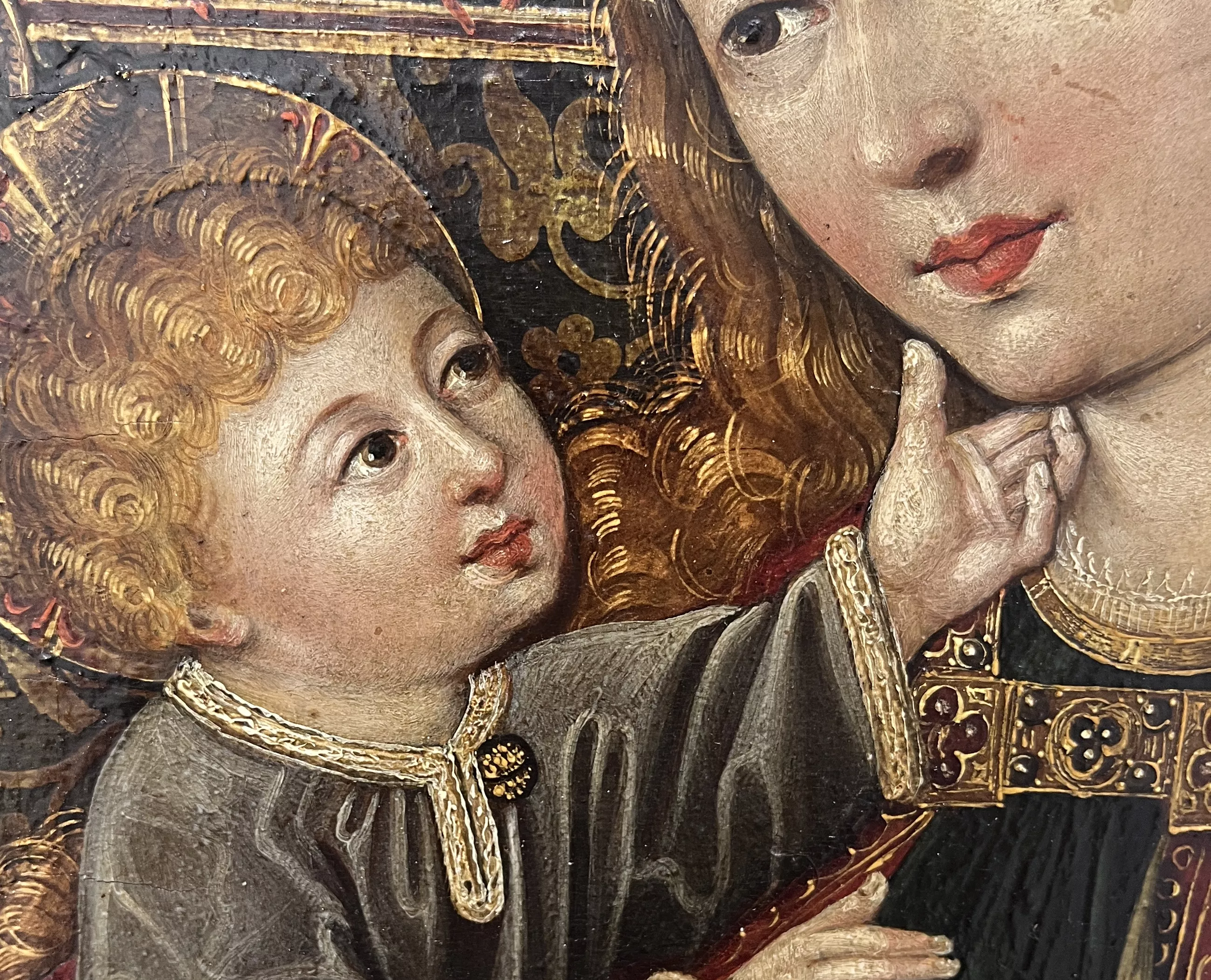
Rediscovery of a rare and precious medieval Alsatian Madonna, contemporary with Martin Schongauer, survivor of the Iconoclasm
The work we have the pleasure of presenting for sale is a rare testimony to the teeming artistic hotbed that was Alsace in the second half of the 15th century, a territory of confluences, wealth, culture, which counted in Strasbourg one of the largest cities in the Germanic world.
The study of painting in the Upper Rhine in the 15th century poses many problems for historians, as the precise location of works in the various artistic centers of this region (Basel, Freiburg im Breisgau, Colmar, Strasbourg, Haguenau) is far from unanimous. While Alsatian sculptors have been well studied (Nicolas Gerhaert de Leyde, Nicolas de Haguenau), we are less familiar with 15th-century Alsatian pictorial production, which suffered considerably from the ravages of iconoclasm during the so-called Reformation (1524-1530). Our Virgin of Tenderness is a hybrid image, both in its own unique form and in its likely multiple sources. In terms of form, it appears to be an evolutionary milestone between three modes of representing the Virgin and Child, inherited from the Byzantine world.
Particularities of the composition
Our Virgin shows a formal evolution through the naturalistic representation of two reciprocal affective impulses between Mother and Child. The Child's left hand rests delicately on his Mother's chin, while his right hand, which often makes the gesture of blessing, or holds in its hand an apple, symbol of Salvation and payment of the Adamic debt, merges, in a gesture of encounter with his Mother's left hand.
Stylistic recontextualization of the Virgin of Tenderness
In its more recent sources, our Virgin of Tenderness is a perfect example of this international Gothic context driven by often nomadic artists, who crossed paths on their tours of companionship or, from courtyards to cities, in search of sponsors.
In Alsace, this was the case of Ulrich d'Ensingen, master builder of Strasbourg Cathedral from 1499, who also worked in Ulm, Esslingen, Basel and Milan. Hans Hertsnabel, a Strasbourg-born artist, is mentioned at the papal court in Avignon in 1377. Hans Tiefental, a painter born in Sélestat, stayed at the ducal court of Burgundy: he then worked in Basel between 1418 and 1423. These artists scrupulously observed each other's work, borrowed motifs from each other and produced variations on the same theme: this period - more than any other - was one of circulating models.
Among the artists who seem to us to have preceded and influenced the author of our Virgin of Tenderness, we would like to mention Jost Haller, who appeared shortly before 1440 in the city of Strasbourg, identified in 1980 by Charles Sterling and whose knowledge proves essential for a better understanding of 15th-century Alsatian painting. Jost Haller left Strasbourg between 1447 and 1450, worked in Metz and settled in Saarbrücken, where he is still mentioned around 1470. A side panel of an altarpiece, preserved in Dijon (Musée des Beaux-Arts, inv. D91), recently considered to be from his
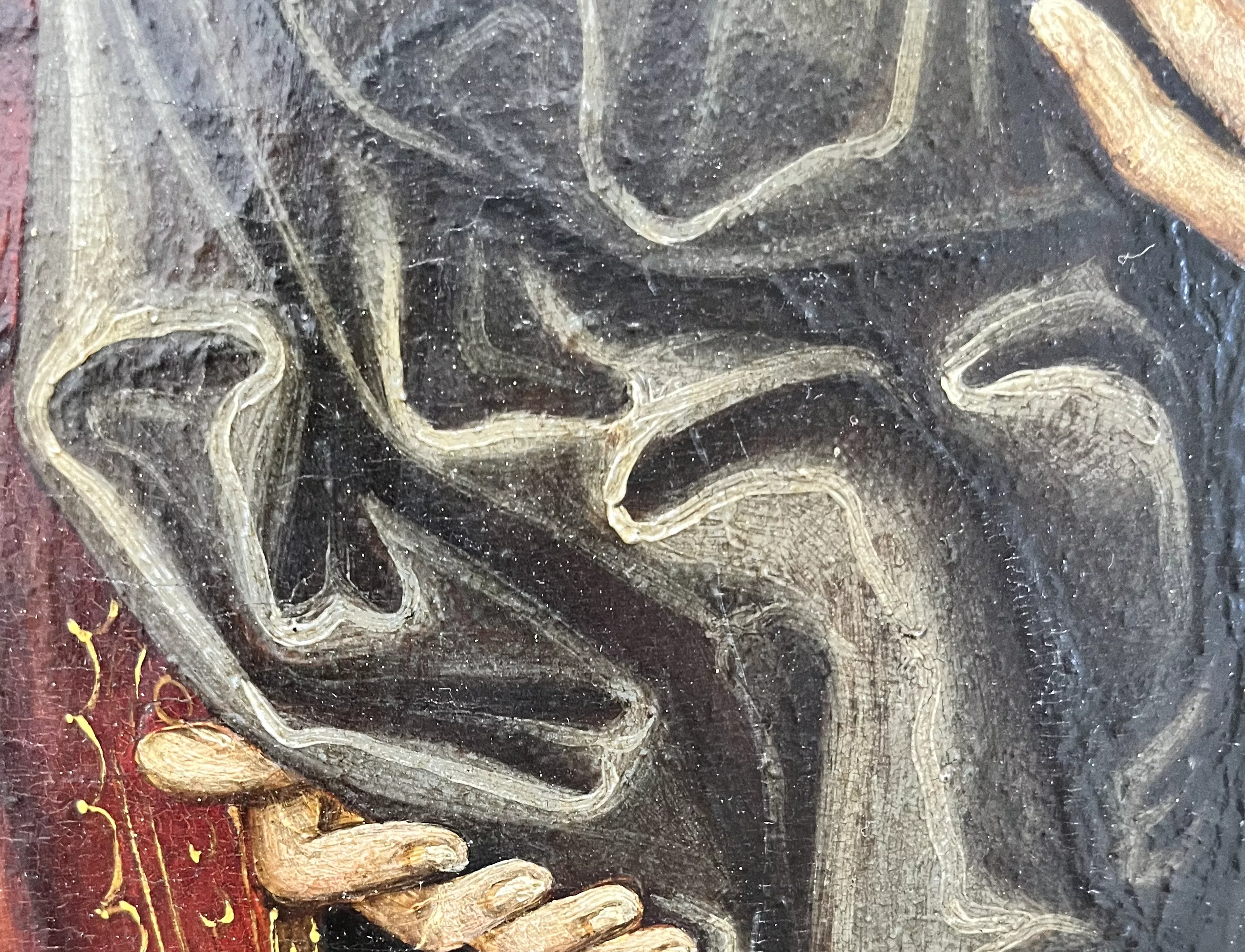
"entourage", depicting Saint Agnes and Saint Emerentius, seems to us to present, in the morphology of the faces, a certain stylistic proximity (regular oval, very high forehead, nose-mouth eye set very concentrated on the lower half of the face, small mouth with thick lips).
Dating and location
We'd be inclined to date our Vierge de Tendresse before the prolific altarpiece production of the 15th century, more in the decade of 1460.
This would place it as contemporary -or possibly a little earlier- of the essential artist of this pre-Renaissance Alsace: Martin Schongauer (1440/1445 - 1491) having set up his studio in Colmar in 1471.
His Madonna with Crescent (a copy in London, British Museum, dated between 1469 and 1473, seems to us to testify to a close look, although Schongauer initiated this vein of Marian representations detached from an "earthly" and architectural environment, but already placed himself in an "apocalyptic" atmosphere, where the supernatural world invites itself into the image: abstract cloud, crescent, crowning by angels, radiance, etc.
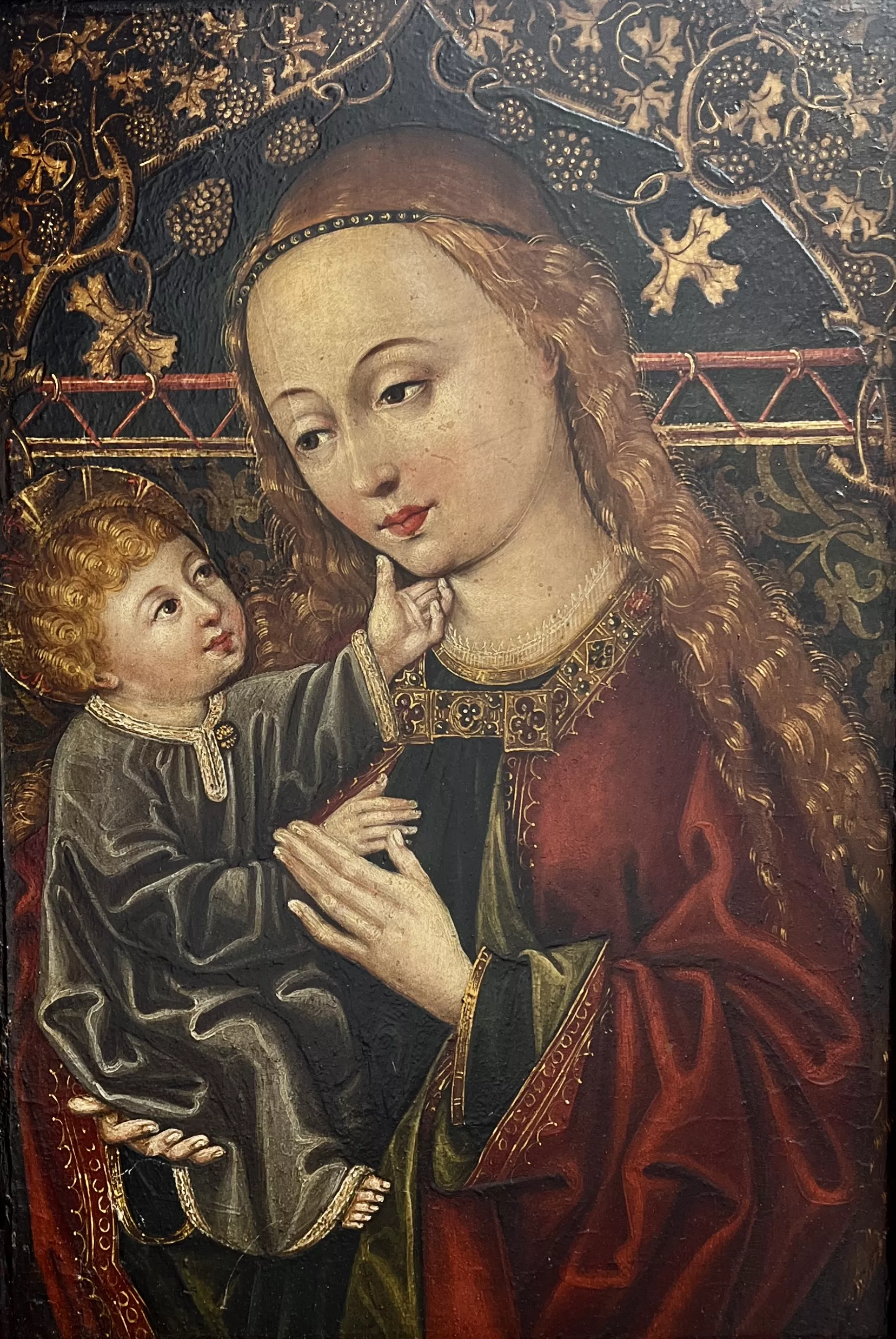
Our Virgin of Tenderness is sure to hold many more discoveries in store for historians wishing to examine her destiny over more than five centuries. So few medieval works from this fertile region have come down to us, due to historical turpitudes and iconoclastic fanaticism, that the reappearance of our Virgin -what's more in a remarkable state of preservation- should be seen as happy news for the knowledge of Alsatian art.
Acknowledgements
We would particularly like to thank our seller for the invaluable details provided on the provenance and history of this Virgin of Tenderness, and also our expert, Pierre-Antoine Martenet, for his indispensable information.
Inscrivez-vous avec votre adresse e-mail afin de recevoir les catalogues de nos futures ventes
